
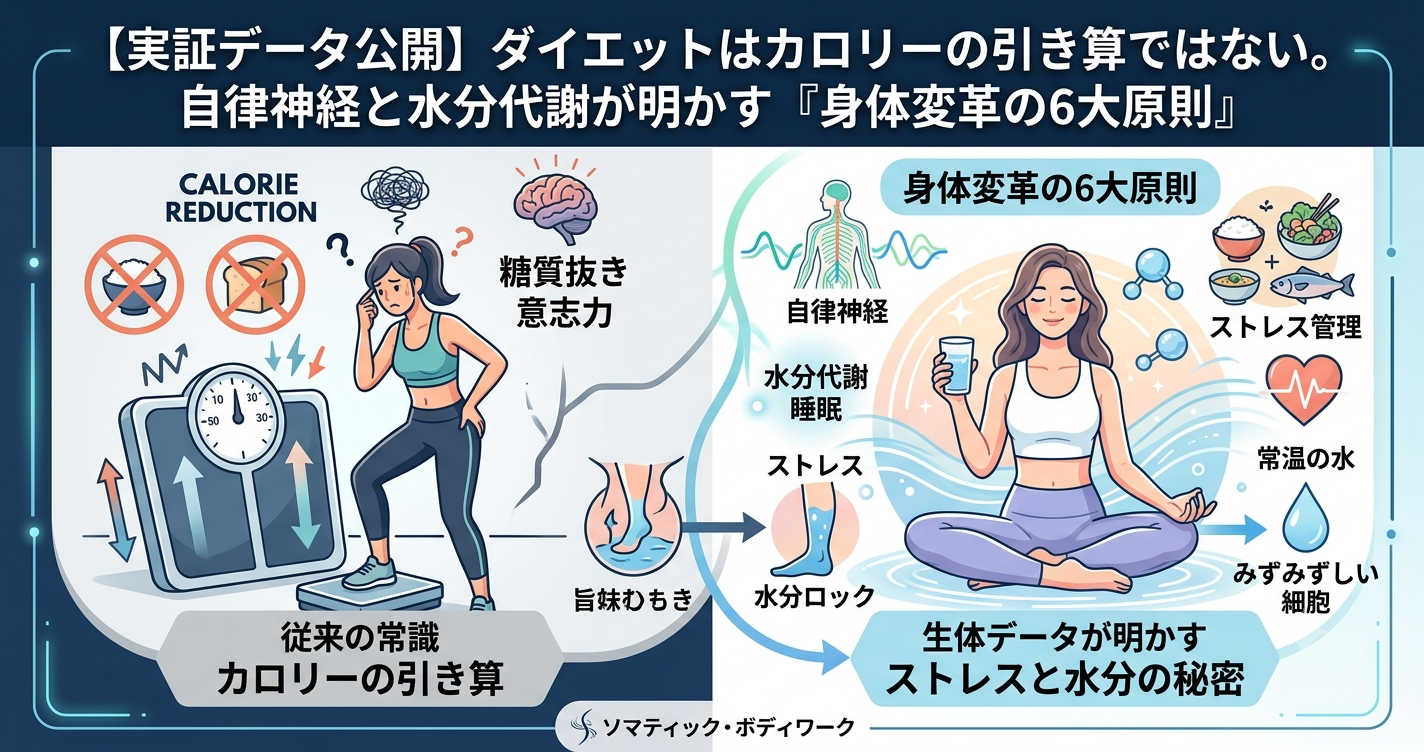
"If I eat less and exercise more, I should lose weight."
"I cut out carbohydrates, yet my body feels heavy, sluggish, and swollen..."
"The body fat percentage on my scale went up, and it completely discouraged me."
Have you ever blamed yourself when you diligently followed conventional diet rules, only to end up without the results you hoped for?
The truth is, it is not a lack of willpower, nor is it insufficient effort. The human body does not operate on a simple mathematical formula of "adding and subtracting calories."
As a specialist in somatics (mind-body connection and sensory awareness), I conducted an exhaustive 33-day study tracking my own biometric metrics (autonomic nervous system balance, heart rate, body weight, and body fat percentage) daily using research-grade heart rate sensors and a nervous system monitoring system (Soma Tracker).
Here are the authentic rules of the human body, the autonomic nervous system, and fluid metabolism that textbooks and commercial advertisements rarely discuss.
Key Takeaways of This Article
Insights from 33 days of biometric tracking that overturn conventional diet wisdom:
- Stress and Water Retention ("Fluid Lock"): Sleep deprivation and tension trigger hormonal shifts that cause the body to hoard water—the true cause behind sudden weight spikes.
- Modern Chronic Dehydration: Alcohol, refined sugar, and excess sodium pull water out of your cells, concentrating fluid retention beneath the skin while leaving internal cells desiccated.
- The Body Fat Percentage Paradox: When excess water sheds and the body becomes leaner, bioelectrical impedance scales often show a temporary increase in body fat percentage due to how they measure electrical conductivity.
- Carbohydrates Are Essential: Drastic carbohydrate restriction destabilizes the autonomic nervous system. Eat quality carbohydrates for breakfast and lunch, and give the digestive tract a resting window at night.
- The Diet Industry's Business Model: Many commercial diets rely on rebounds for customer retention. Understanding how the body actually works protects you from sensational claims.
The Reality Behind the Diet Industry's Rebound Economy
Before diving into the core principles, it is essential to understand why mainstream diet trends are so extreme.
Every year brings an endless stream of new diet fads, supplements, and fitness programs. Consider this: if a simple, sustainable method that prevents weight regain permanently were widely adopted, what would happen to the diet industry?
Its business model would collapse.
💡 The Cycle of the Diet Business
- Promote Extreme Restriction: Methods like cutting carbohydrates to zero or severely cutting calories cause rapid water loss, giving clients an immediate sense of success.
- The Nervous and Hormonal Systems Sound the Alarm: Starvation and high stress signal danger to the brain, driving intense cravings and severe fluid retention.
- The Rebound Occurs: Returning to normal eating prompts the body to store water and fat even more aggressively as a survival mechanism.
- Self-Blame and Repeat Purchases: People assume their willpower failed, leading them to purchase the next supplement or program.
The entire commercial cycle depends on rapid weight loss, inevitable rebounds, and self-blame to sustain itself economically.
Breaking free requires stepping away from marketing slogans and honoring the body's innate intelligence—specifically the autonomic nervous system and hormones.
1. Weight Fluctuations Are Governed by the Autonomic Nervous System, Not Calories
Have you ever woken up heavier after a stressful day or poor sleep, even without overeating?
That sudden weight gain is not fat. It is the autonomic nervous system responding to stress by shifting into fluid-preservation mode ("fluid lock").
💡 What Happens Inside the Body
Extended screen exposure, interpersonal tension, and sleep deprivation prompt the brain to register a threat, releasing the stress hormone cortisol.
Cortisol signals the kidneys to retain sodium and conserve water to preserve life. Consequently, your body can hold onto 0.5 kg to 1.0 kg of water overnight, driving up the number on the scale.
Empirical Data: Across the 33-day tracking period, long-distance driving or poor sleep triggered weight spikes of +0.3 kg to +0.8 kg. Conversely, eliminating late-day caffeine and securing deep sleep released this hormonal lock, resulting in natural overnight drops of up to -0.7 kg.
2. Modern Living Causes "Cellular Dehydration"
Restricting water intake out of fear of bloating produces the opposite of the desired effect.
Diets heavy in alcohol, refined sugar, and high-sodium foods create a state of cellular dehydration—where fluid is pulled out of internal cells and pools in the interstitial spaces under the skin.
| What You Consume | Internal Physiological Reaction | Visual & Physical Effect |
|---|---|---|
| Alcohol | Inhibits antidiuretic hormone (ADH); strips water from cells and the brain. | Acute dehydration followed by severe rebound puffiness. |
| Refined Sugar | Spikes insulin, prompting the kidneys to retain sodium and water. | Spongy, loose-looking skin texture. |
| Ramen / High Sodium | Draws water out of cells into extracellular space to dilute sodium concentration. | Heavy puffiness in the face and limbs. |
Drinking room-temperature water and non-caffeinated teas (such as Job's tears / hatomugi tea) helps flush out stagnant sodium and restores hydration to the cells themselves.
3. Scales Do Not Measure "Only Fat"
Seeing your body fat percentage jump by 1% overnight can be disheartening. Physiologically, however, it is impossible to gain hundreds of grams of pure adipose tissue in a single day.
💡 How Body Composition Analyzers Work (Bioelectrical Impedance Analysis)
Home scales run a weak electrical current through your feet to estimate body fat based on electrical resistance:
- Water: Conducts electricity efficiently (low resistance).
- Fat: Does not conduct electricity well (high resistance).
When your body sheds excess extracellular puffiness, electrical conductivity slightly decreases. The analyzer misinterprets this drop in conductivity as an increase in fat, temporarily displaying a higher body fat percentage.
A drop in weight paired with a slight bump in body fat percentage often indicates that excess fluid retention has cleared and your tissue is tightening up.
4. Why Cutting Out Carbohydrates Is Dangerous
The belief that eliminating rice and grains leads to sustainable weight loss overlooks key biological needs.
Carbohydrates supply the primary fast-acting fuel for the brain and are vital for down-regulating the sympathetic nervous system into a relaxed parasympathetic state. Complete elimination depletes intramuscular water—leaving muscle tissue looking deflated—while elevating sympathetic arousal, which leads to insomnia and irritability.
💡 A Balanced Strategy: Eat Early, Rest Late
- Breakfast & Lunch: Consume quality carbohydrates (such as whole grains or rice) to fuel daytime physical activity and sustain metabolic rate.
- Dinner: Reduce evening carbohydrates and center the meal on protein and vegetables to let the digestive system settle.
- A 12–14 Hour Fasting Window: Allowing 12 to 14 hours between dinner and breakfast optimizes lipase activation, enabling natural fat metabolism during sleep.
5. Water Retention vs. Muscle Turgor: Two Very Different States
Holding water is not inherently negative; its location in the body is what matters.
- Fluid Retention / Edema (Extracellular Water): Stored beneath the skin due to stress and excess sodium. This softens definition and creates a sluggish, swollen feel.
- Muscle Turgor (Intracellular Water): Stored inside muscle cells through regular movement and nourishment. This creates firm, resilient muscle tone and supports a healthy resting metabolic rate.
Following demanding resistance training such as squats, body weight can temporarily rise by roughly 0.5 kg. This reflects an influx of fluid directed toward repairing micro-tears in muscle fibers (supercompensation). Once recovery completes a few days later, that fluid clears, revealing a more toned physique.
6. Rely on Personal Biometrics Over External Rules
Physical constitutions, daily habits, and stress responses differ from person to person. A workout or meal plan that benefits one individual may not suit another.
True progress comes from tracking your own trends—heart rate variations, sleep architecture, and energy shifts—to create an individualized manual for your body.
- "My heart rate stays elevated and my neck tenses after long virtual calls; I need deep breathing exercises."
- "When afternoon caffeine cravings hit, activating my calves helps restore circulation."
- "Alcohol fragments my sleep; I need to drink extra water and get to bed earlier."
Listening to internal signals and making small, informed adjustments creates sustainable, lifelong health free from rebound cycles.