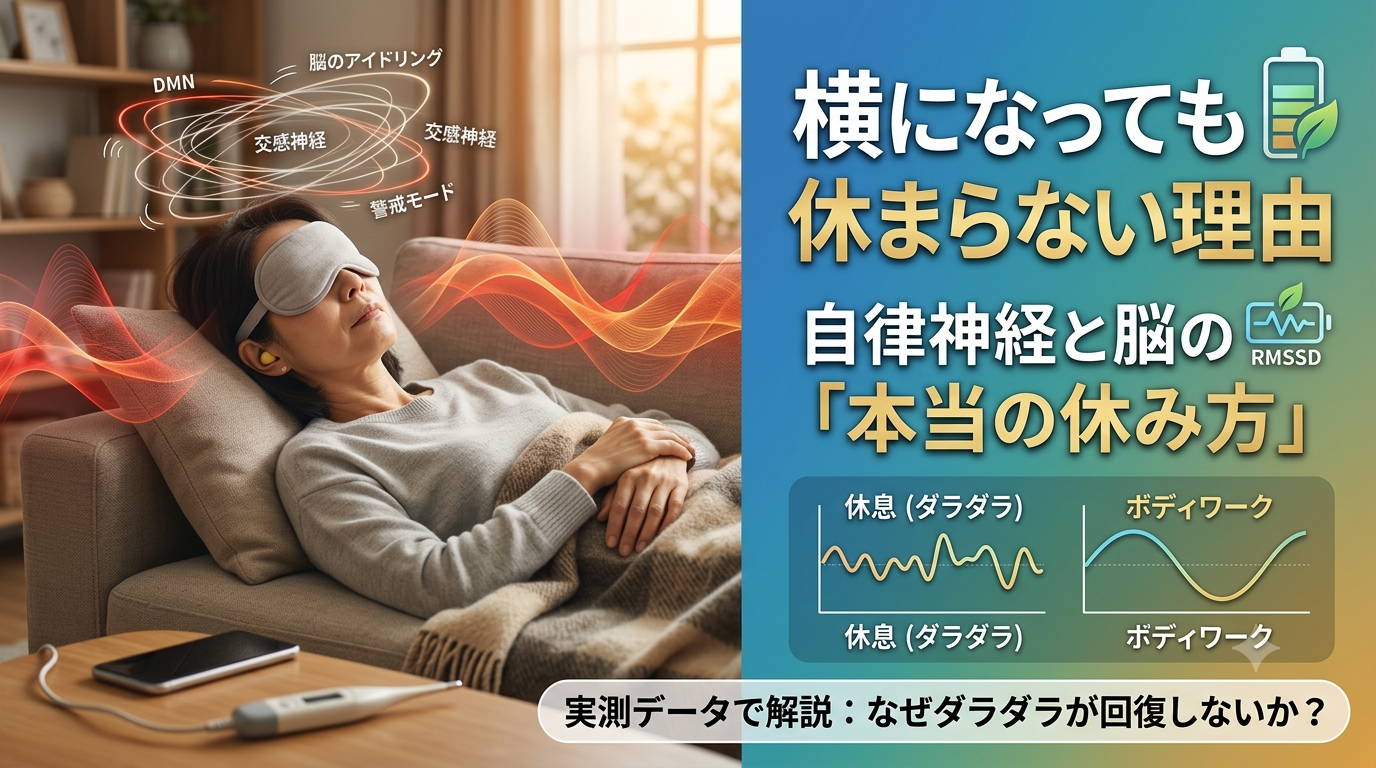
“Today, weary and spent, I shall simply surrender to the quiet embrace of home, reclining in gentle repose.”
And yet, after a day intended for such rejuvenation, have you ever awakened the following morning to find your being inexplicably heavy, your mind still clouded, “lacking that refreshing clarity”?
The truth is, the gentle act of resting the muscles – merely reclining – is profoundly distinct from the deeper restoration required by our autonomic nervous system and brain.
In this piece, guided by empirical data, we will unravel the essence of this “state of unyielding weariness, despite passive repose.” We will illuminate the subtle approach that gracefully coaxed an autonomic nervous system, which had lost its innate ability to engage the brakes of restoration, back into a tender harmony.
【Key Insights within this Exploration】
- We delve into why, even as the body rests, the autonomic nervous system remains tethered in a state of tension, often due to the prior day's hyper-arousal and the persistent hum of the Default Mode Network (DMN)—the brain’s unconscious ‘idling’.
- We unravel the compelling evidence supporting ‘subtractive self-care’—an approach that gently releases the need for willpower—as a profound pathway to restoration when the nervous system is depleted and yearning for respite.
- Through the precise data revealed by Soma Tracker, we shall unveil the supple, resilient shifts in autonomic nervous system recovery, gracefully brought forth by merely 20 minutes of delicate bodywork.
1. Unveiling the Prior Day's Data: The Brain, Even in Repose, Remained in a 'State of Vigilance'
The individual we observed was my wife, in her 50s.
Remarkably, she had just returned from a profound experience the previous evening: a two-hour gospel live performance on stage with over 200 fellow artists, an immersive commitment of ten hours including rehearsals.
The dazzling stage lights, the fervent gaze of the audience, and the profound act of channeling her voice from the very core of her being, engaging every muscle and breath.
For the delicate balance of the autonomic nervous system, this symphony of experiences represents an extraordinarily active engagement, fully activating the 'sympathetic nervous system' – the body's natural accelerator.
The morning after the triumphant live performance, following a night’s sleep, she was enveloped in a profound sense of 'accomplishment, intertwined with deep fatigue.' She chose to spend the day in gentle repose at home, yet her inner experience whispered, 'I somehow feel no sense of true rest.'
Prompted by this inner discord, we turned to the Soma Tracker, a device capable of measuring her autonomic nervous system in real-time. The objective data it revealed is presented below.
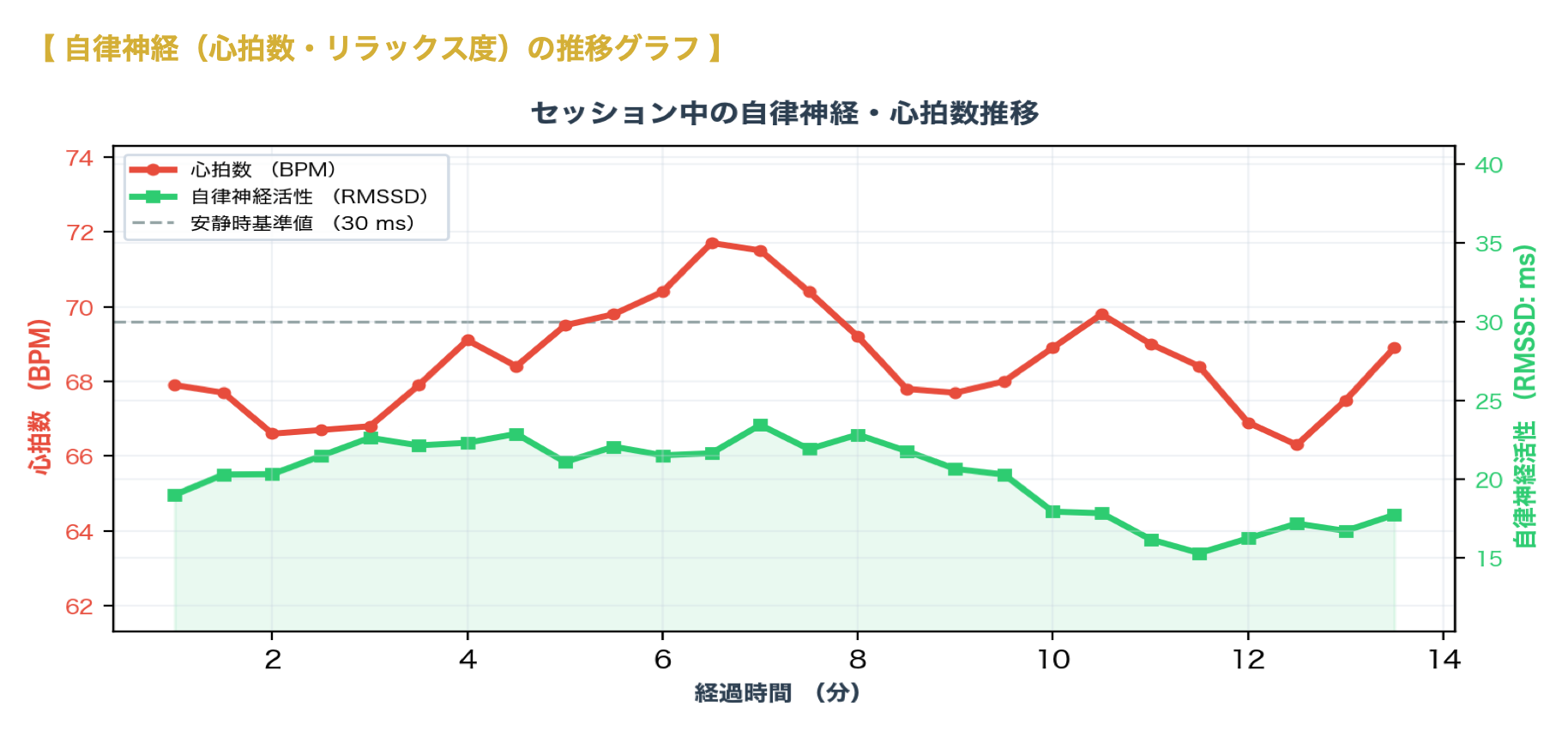
Soma Tracker measurement taken on the evening following the gospel live performance
- 📊 Average Heart Rate: 68.8 bpm (Her heart rate remained placid, as she was in a state of repose)
- 🔋 Autonomic Nervous System Vigor (RMSSD): 19.94 ms (A profound metric of the autonomic nervous system’s foundational resilience and recuperative capacity; the average is 30 ms)
- 🧓 Autonomic Nervous System Age: 85 years (A stark +28 years beyond her chronological age of 57!)
- ⚖️ Autonomic Nervous System Equilibrium (LF/HF): Initial 1.97 → Concluding 8.14 (An intensely heightened state of sympathetic dominance, indicative of an unyielding 'alert mode')
■ The Lingering Echoes of Adrenaline: A Nervous System Entrapped
Though her muscles lay still, gently reposed, her autonomic nervous system equilibrium registered a profound state of tension, an unsettling 8.14.
The underlying reason was the cascade of stress hormones, particularly adrenaline, profusely secreted during the previous night's live performance. These lingered in her bloodstream, effectively locking her nervous system into an unyielding 'state of arousal and vigilance.'
Her body's intrinsic self-restoration capacity (RMSSD) had dwindled to a dangerously low 19.94 ms. As she lay in passive repose, this depletion was compounded by the 'lingering echoes of the previous night’s performance and the relentless current of ruminative thoughts (DMN: the Default Mode Network's excessive activation),' rendering her brain's subconscious ‘idling’ ceaseless.
In essence, she found herself in a state where 'the very capacity to engage the brakes of recovery—to tap into her parasympathetic nervous system—was utterly depleted, leaving no inner spaciousness to find stillness.'
2. The Art of 'Subtractive Self-Care' When the Brain Cannot Find Its Own Pause
For an individual experiencing such a 'profound depletion of nervous system energy,' suggesting practices like 'Now, let us meditate and quiet the mind' or 'Breathe deeply, connecting to your breath' can paradoxically become an additional burden.
The very act of striving for control through conscious effort and willpower can inadvertently introduce further stress to an already exhausted brain.
The path of true efficacy lies in 'subtractive self-care,' an approach that bypasses the active mind and instead gently coaxes a shift towards the parasympathetic nervous system through the subtle whispers of bodily sensation and the five senses.
-
The Embrace of Gentle Weight and Soothing Warmth:
Drape a gently weighted blanket over the body, imparting a comforting sense of groundedness. Apply warm compresses or hot packs to the 'eyes' and the 'nape of the neck'—a vital confluence of pathways for the nervous system. This simple act alone transmits profound reassurance to the brain, gently inviting forth a resonance of recovery. -
Cultivating Inner Stillness by Gently Halting External Input:
Physically place your smartphone in a separate room. Then, don an eye mask and earplugs, softly disengaging the flow of external sensory input to the brain, creating an exquisite internal spaciousness. -
Tender Immersion of the Senses (Auditory):
Allow the gentle cadence of natural sounds—the soft patter of rain or the rhythmic whisper of waves—to play softly. By suffusing the auditory cortex with these serene inputs, the mind’s innate spaciousness is gently reclaimed, naturally diminishing the entry points for 'unnecessary mental chatter.'
3. The Lingering Stagnation of the Following Morning, and the 'Quiet Harmony' Unfolded by 15 Minutes of Bodywork
As dawn broke the following morning, a new measurement with the Soma Tracker revealed that despite a night’s sleep, the autonomic nervous system still carried the echoes of yesterday's tension and rigidity. (This was evident in the data captured during the first five minutes of measurement in the figure below.)
She had awakened to a new day, yet the patterns of mental exhaustion and hyper-arousal remained subtly entrenched.
Thus, for her, as she roused from sleep, we introduced 'a concise 15-minute Unfolding Bodywork session—a tender, hands-on approach.'
Rather than forceful manipulation, our touch was a gentle communion with the subtle receptors within the skin and fascia, delivering a quiet, profound message directly to the nervous system: 'You are safe; there is no longer a need to strive or contend.'
The outcome was a remarkably serene and undeniable restoration of her autonomic nervous system. (As observed from the five-minute mark onwards in the measurement data below)
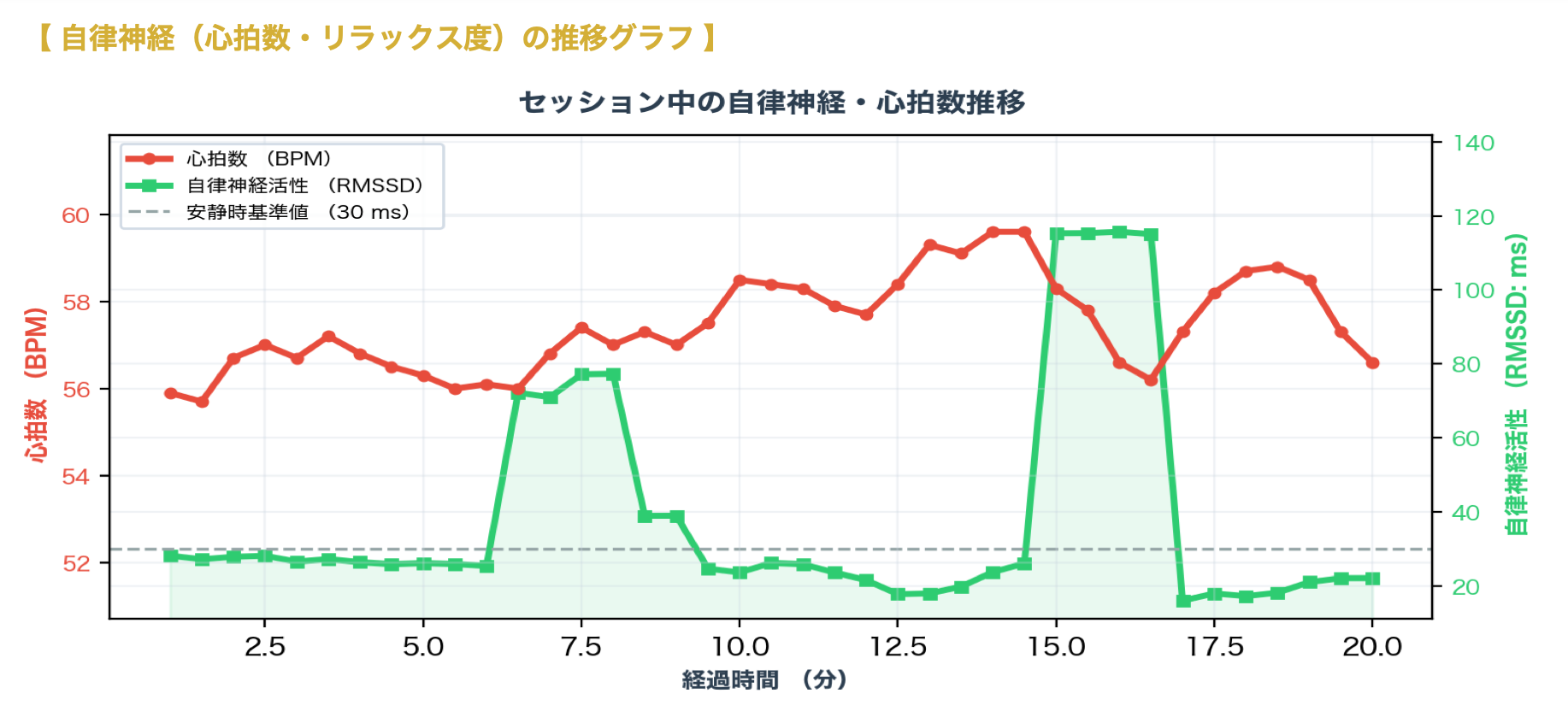
Session commenced 5 minutes after the initial measurement
| Measurement Metric | Previous Evening (Passive Repose) | Post-Bodywork Approach (Following Morning) | Autonomic Nervous System Transformation |
|---|---|---|---|
| Autonomic Nervous System Vigor (RMSSD) | 19.94 ms | 47.75 ms | Recuperative capacity gracefully rose to 'approx. 2.4 times' |
| Autonomic Nervous System Age | 85 years | 50 years | A state where innate healthy spaciousness was reclaimed |
| Autonomic Nervous System Equilibrium (LF/HF) | 8.14 (Vigilance Mode) | 1.38 (Overall Average) | Settled into an ideal state of serene relaxation |
Remarkably, despite this brief and gentle approach, the foundational vigor of her autonomic nervous system (RMSSD) surged dramatically to 47.75 ms (equivalent to an autonomic nervous system age of 50 years), and the overall equilibrium of her nervous system beautifully harmonized into an ideal state of deep relaxation (1.38).
It was a poignant moment when the very brakes of restoration, which her system could no longer engage on its own, were tenderly released by 'the secure, resonant sensations offered externally through bodywork.'
4. The Intriguing 'Lag' Between Subjective Sensation and Objective Data
Intriguingly, her immediate subjective experience post-session was one of 'still feeling a slight sluggishness, a lack of complete clarity.'
This, in fact, is a commonly observed phenomenon in the clinical landscape of the autonomic nervous system: the 'temporal lag between profound shifts in the nervous system and one’s immediate, conscious bodily sensation.'
During that delicate transitional phase, as the body settles into a profound state of relaxation (with an average heart rate of 57.4 bpm) and the brain gently begins to reawaken, the very sensations of profound release and gentle yielding can, at times, be perceived as a subtle 'heaviness.'
However, because the inner spaciousness of the autonomic nervous system (RMSSD 47.75 ms) was already profoundly replenished, within one to two hours of rising and resuming her daily rhythms, she would gradually begin to perceive her authentic sense of ease, albeit with a gentle temporal delay:
'Indeed, my body moves with such effortless grace today.'
'My mind feels quiet and exquisitely clear.'
Conclusion: Bodywork as the 'Science of Resonant Sensation'
When the weariness lingers, even amidst passive repose—when you 'lie down idly, yet find no respite'—it is possible your autonomic nervous system is silently crying out, unable to engage its own profound brakes of restoration.
The sessions offered by Unfolding Bodywork transcend the realm of mere muscle manipulation; they are not simply massages that forcefully release tension.
Instead, they are a profound process designed to tenderly transmit a sensation of 'deep security' through subtle, perceptive touch to a nervous system that has forgotten how to find its own stillness. This gentle engagement empowers the body to spontaneously activate its inherent recovery mechanisms, unfolding into a state of profound well-being.
If you find yourself in the poignant experience of 'resting, yet remaining unrestored,' we warmly invite you to journey inward and discover the profound 'unfolding' that awaits your autonomic nervous system—a true homecoming to your inner balance.