Hello. I am Yasuhiro Terashima from Unfolding Bodywork.
“I spent the whole weekend lounging at home, yet my body feels heavy from Monday morning...”
“I am certain I am getting enough sleep, yet a hazy, lingering exhaustion remains deep within my mind...”
Have you ever experienced this?
When fatigue sets in, we naturally tend to think, “Let me lie down and rest.”
However, much of the modern person’s exhaustion goes far beyond simple physical fatigue from overusing muscles. It is very often “mental fatigue” caused by continuously turning thoughts over and over in our minds throughout the day.
And this deep mental fatigue rarely dissolves simply by lying still in repose.
I speak from my own experience. In my twenties, I suffered from severe hypertonicity, leaving my back rigid and locked. No matter how much I slept, the fatigue never lifted; I could not even roll over, waking up feeling exhausted every morning. That very experience became the catalyst for creating Unfolding Bodywork. Living then in a professional environment that demanded constant vigilance, I now understand that such exhaustion was, in hindsight, entirely inevitable.
Today, drawing upon data gathered through our autonomic nervous system measurement system, the “Soma Tracker,” we will explore why our thoughts cause the body to constrict, and how we might empty the heart to reclaim a state of true harmony.
[Highlights of This Article]
- An exploration of how the Default Mode Network (DMN)—the brain idling as it ruminates on worries—depletes the body's energy.
- Unveiling the profound connection between late-recovery sleep patterns, emotional detox (REM sleep), and the deep release of bodily tension.
- An invitation to embrace the senses and non-invasive bodywork to empty the heart, rather than forcing ourselves to relax.
1. Why Most Modern Fatigue Is “Mental Fatigue”
■ The Brain Consumes the Vast Majority of Energy Merely by “Thinking”
Neuroscience research reveals that while the brain accounts for a mere 2% of our body weight, it consumes approximately 20% of our total bodily energy.
Even more fascinating is that 60% to 80% of that energy is used not when performing a specific task, but during moments when we are doing nothing at all, while past regrets and future anxieties swirl continuously within the mind (the Default Mode Network, or DMN).
- “How should I approach that project?”
- “What did those words they said to me actually mean?”
- “Have I prepared enough for tomorrow...?”
Even without our conscious awareness, our minds operate at full throttle around the clock.
As long as thoughts continue to echo within, our brain and nervous system remain relentlessly active, depleting our reserves, even if our physical body is entirely still.
■ To the Autonomic Nervous System, “Real Danger” and “Mental Worry&rdquo Are One and the Same
In primordial times, the sympathetic nervous system (our tension and action mode) functioned as an emergency alert, triggered only when tangible danger loomed close.
In the modern world, however, even in the absence of physical peril, merely “worries and pressures held within the mind” prompt the brain’s amygdala to sound a warning, accelerating the heartbeat and causing muscles to tense.
This is the true nature of unconscious tension (mental fatigue) that lingers stubbornly even after we slip beneath the covers.
2. The Profound Connection Between “Emotional Processing” and “Physical Restoration” Revealed in Sleep Data
Observing the autonomic nervous system data (nighttime sleep analysis) that I regularly monitor reveals a fascinating rhythm of rest.
Those who habitually ponder deeply or expend energy finely attuning to the needs of those around them tend to exhibit a sleep rhythm known as the “Late-Recovery Type.”
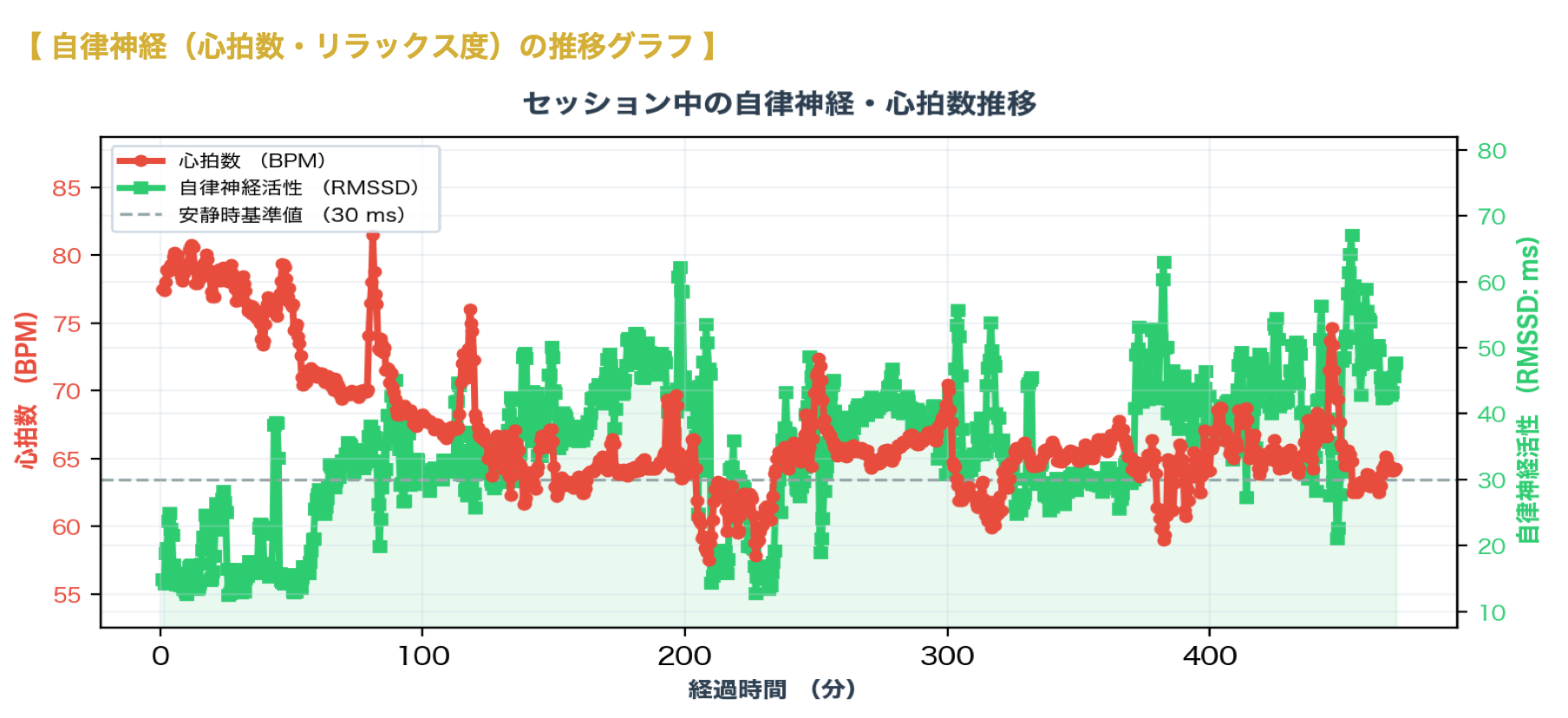
Graph showing heart rate and autonomic nervous system transitions during sleep
▲ Actual sleep data: In the first half of the night (10:00 PM to 11:00 PM), the residual heat of thought keeps the heart rate (red line) elevated and tension present, yet by 5:00 AM, alongside emotional detox, the degree of relaxation (green waveform) surges explosively by +230%.
[Steps of the Late-Recovery Sleep Pattern]
Residual traces of thought and daytime responsibilities linger, making unconscious defenses difficult to lower and keeping sleep light.
REM sleep (dreaming) cycles through, quietly organizing daytime emotions and unprocessed thoughts.
The moment the brain accepts that “there is no longer any need to protect myself (we are safe),” the parasympathetic nervous system gracefully rises, ushering in a deep cycle of restorative rest.
Within sleep, REM sleep—the realm of dreams—is often referred to as “emotional detox time.”
Within the safe, untouched environment of slumber where the stimuli of stress cannot reach, it serves as a precious period to gently smooth away the sharp edges of the previous day's emotions.
The undeniable insight this data offers is that “only when the emotional tension of the mind (the rigidity of thought) begins to unwind can the muscles and blood vessels of the body truly soften from within.”
Mind and body are inextricably linked, far more deeply than we often realize.
3. Why Trying Hard to “Relax” Backfires
“Then I need to quiet my thoughts and relax right away!”
Have you ever thought this, forcing your eyes closed, taking repeated deep breaths, or trying earnestly through meditation to “become nothing”?
In truth, this is the very pitfall of the mind into which modern people so easily fall.
■ The “Intent to Control” Is Itself an Act of Thought
The very act of attempting to control things mentally by telling yourself, “I must relax quickly” or “I must stop thinking,” is already an engagement of “thought (the accelerator of the sympathetic nervous system).”
When the nervous system is taut, forcing oneself to confront the inner self can cause the brain to feel anxious about becoming vulnerable, paradoxically intensifying tension even further.
The mind cannot quiet the mind through sheer willpower.
The body’s defense switches only turn off spontaneously when we let go of the intention to control and naturally feel a sense of safety.
4. The Pathway to Surrendering Thought and Emptying the Heart: The Senses and Spaciousness
The surest and gentlest way to quiet the loops of thought and empty the heart is “to bypass thought and entrust awareness to the bodily senses (the mode of feeling).”
In moments when our senses whisper, “This feels wonderful” or “This is warm,” the domain of thought that governs language naturally rests.
[A 3-Minute Daily Practice for Emptiness]
- Close your eyes and simply, quietly savor the aroma of freshly brewed tea or coffee. (Though note that caffeine can shift the body toward sympathetic activation.)
- Witness the warmth of a hot beverage as its comfort travels from your throat down into your core.
- Gaze softly, without evaluation, at the blue of the sky or the swaying of the trees beyond your window.
- Simply entrust your awareness to the sensation of the soles of your feet resting against the earth.
Through these simple acts alone, the brain’s energy drain (the DMN) gently subsides, and a supple sense of “space” returns to the autonomic nervous system.
5. What Unfolding Bodywork Holds Most Dear
When daily responsibilities and pressures accumulate, and you find yourself unable to switch off the constant hum of thought on your own— Unfolding Bodywork is here to offer a sanctuary of support.
Unlike conventional treatments, we do not “intervene” by applying forceful pressure from the outside to knead away tension.
Strong external stimuli are perceived by the body as a form of control—a message that says, “Your current state must be changed (there is something wrong with you).” The nervous system perceives this as subtle coercion, often prompting it to tighten its defenses rather than let go. Because human beings inherently resist being controlled, the body reacts in kind.
At Unfolding Bodywork, the practitioner releases the urge to control and quietly opens a “safe, receptive field within the nervous system (co-regulation).”
In response, the body instinctively understands: “This is a place where I no longer need to protect myself.”
The moment that realization dawns, the mental defenses held tightly for years begin to soften, allowing the body to unfold spontaneously from within toward its innate, vibrant balance. And that very experience becomes the catalyst that quiets the relentless machinery of your thoughts.
“My vision grew brighter, and the heavy ache deep within my eyes simply melted away.”
Lay Down the Baggage of Thought and Return to the Essence of Life
Every single day, you think deeply and try so very hard.
Precisely because of this, please grant yourself permission to experience a time of “setting down thought and simply emptying the heart,” equal in measure to the time you spend living through the intellect.
When you reclaim the quietude within, your body naturally begins to awaken its inherent, beautiful capacity for self-regulation.
Whenever you feel that daily mental fatigue refuses to lift, we warmly invite you to come and taste the sensation of letting go of thought, allowing mind and body to gracefully unfurl.