Hello, this is Terashima from Unfolding Bodywork.
'Though I savored delightful drinks last night, my body feels inexplicably heavy and sluggish today...'
'I'm more easily fatigued than usual, and there's a subtle, oppressive sensation around my chest...'
Have you, too, experienced such visceral sensations the morning after a social gathering?
While our minds might attribute it to 'drinking too much' or 'not enough sleep,' what truly unfolds within our physical being often remains unseen, doesn't it?
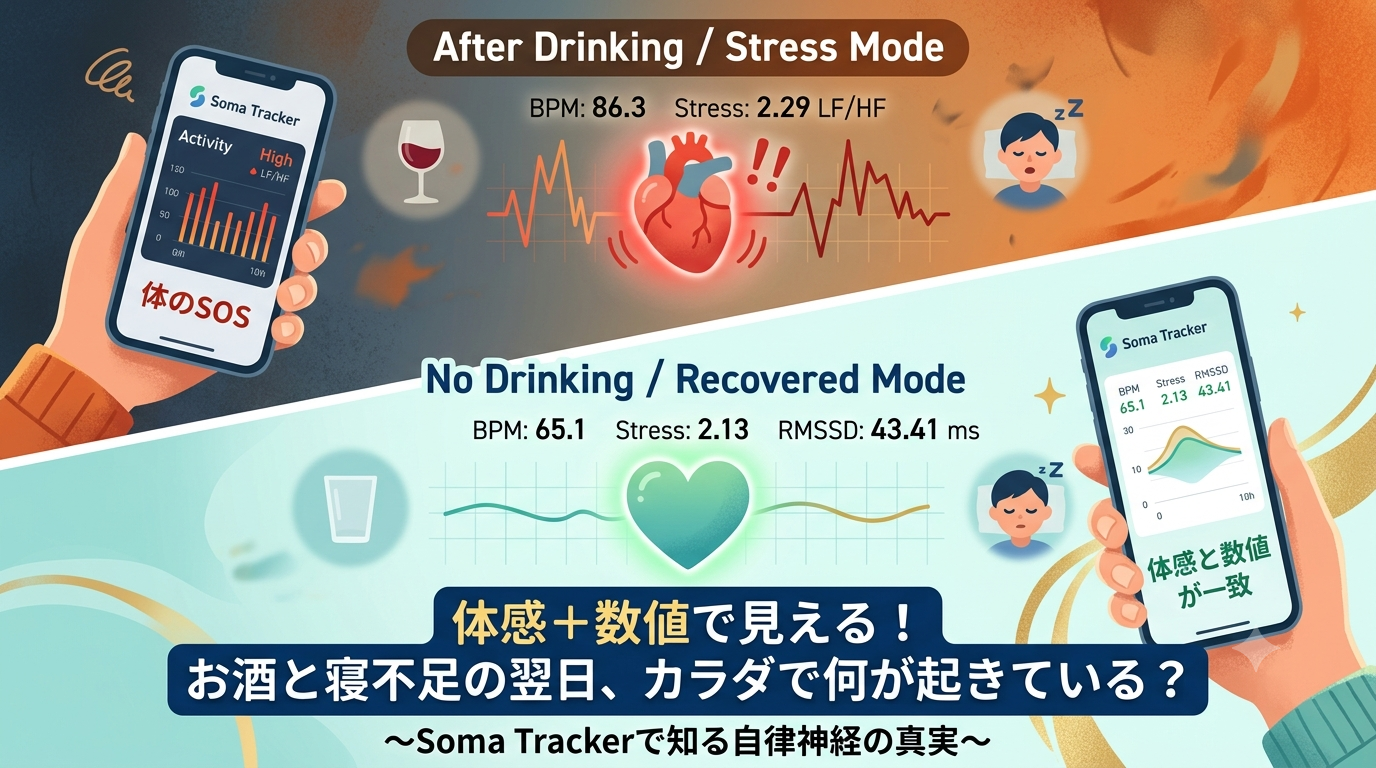
As a matter of fact, just recently, I found myself in precisely this state — 'the day after a gathering, with insufficient sleep' — and decided to measure my own body using the autonomic nervous system assessment system we employ here at Unfolding Bodywork: 'Soma Tracker.'
What emerged from this exploration was a profound truth about the body, revealed only when our 'felt sensations' merge with 'tangible data.'
Today, I wish to share these astonishing insights and the profound understanding of 'the vital importance of nurturing oneself' that blossomed from them.
---
After a night of drinks and interrupted sleep (waking in the middle of the night), I greeted the next afternoon feeling slightly sleep-deprived. My embodied sensations were as follows:
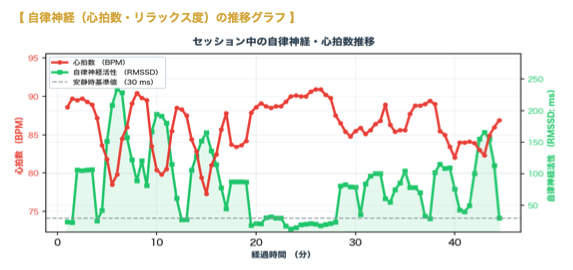
And here are the actual measurements recorded in this state:
> 💡 A Moment of Expert Insight: What are BPM and LF/HF Ratio?
> * BPM (Beats Per Minute): This measures the number of times your heart beats in one minute.
> * LF/HF Ratio (Stress Ratio): This reflects the delicate balance between your sympathetic nervous system (the 'accelerator' of excitement) and your parasympathetic nervous system (the 'brake' of relaxation). A higher numerical value suggests your body and mind are in a 'fight mode' (a state of tension).
Upon seeing these figures, I was struck with a sudden realization. Despite merely sitting and working on my computer, my heart was pounding a fervent 86 beats per minute.
This indicated a state where my heart was performing 'overtime,' beating over 10 extra times per minute compared to its usual rhythm. It was diligently working at full capacity to metabolize the alcohol consumed the day prior and to safeguard my body from dehydration.
The 'weariness' I felt was not imagined; rather, it was a genuine cry (SOS) from my heart, laboring earnestly on my behalf. Witnessing these numbers brought me a profound sense of understanding and validation.
---
Intriguingly, on the day of this measurement, another curious figure emerged:
The value indicating the autonomic nervous system's 'recovery capacity' mysteriously registered far above the average for a healthy individual, appearing exceptionally high (and seemingly positive).
One might wonder, 'If I'm tired from daily beer consumption, why is my recovery capacity so high?' Indeed, herein lies the profound subtlety of understanding the body through quantitative data.
> 💡 A Moment of Expert Insight: What is RMSSD (Recovery Capacity)?
> * RMSSD: This is a calculated value representing the 'millisecond-level fluctuations (subtle variations)' between each successive heartbeat. A healthy heart, especially when relaxed, exhibits a rich variability in these fluctuations.
> * However, when the heart is fatigued or in a state of excessive tension, temporary 'subtle irregularities in pulse (such as skipped beats)' can occur. Measurement devices may mistakenly interpret these minute irregularities as 'rich variability (= high recovery capacity),' thereby yielding an elevated reading.
Therefore, this 'astounding 96.74' was not a sign of a vibrant, healthy body; rather, it was a signal that a heart burdened by 'alcohol and sleep deprivation was desperately attempting to apply the brakes and hold its ground (or was experiencing minor pulse irregularities).'
---
Receiving this SOS from my data, I chose to abstain from alcohol that evening and retired early. I continued to monitor my autonomic nervous system throughout my sleep.
The next morning, upon checking the data, an astonishing 'reset' had transpired.
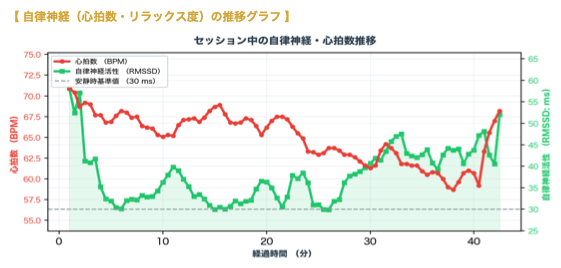
Simply by abstaining from alcohol for one night and indulging in proper sleep, my heart's 'overtime' concluded, and it reclaimed its inherently calm and rhythmic beat. The following morning's awakening brought a clear-headed sensation that perfectly aligned with the measured data.
---
The feelings we experience daily — 'a vague weariness,' 'a sluggishness' — are, in fact, incredibly vital sensations. Yet, amidst our bustling lives, we often tend to dismiss these feelings as 'all in my head' or 'it's probably fine.'
What I truly grasped through this measurement experience was that when 'felt sensation' is complemented by the objective confirmation of 'data,' one gains a more multifaceted and impartial understanding of their body's inherent wisdom.
By visually perceiving these numbers, a profound sense of gratitude spontaneously arises:
'Ah, my heart has been diligently working 'overtime' since yesterday. Thank you. Tonight, I shall ensure it rests early.'
This naturally cultivates a gentle, nurturing sentiment of self-care toward one's own body.
The Soma Tracker, in essence, acts as 'an interpreter, bridging your body and your heart.'
---
At Unfolding Bodywork, we conduct autonomic nervous system assessments using the 'Soma Tracker' during your session.
Beyond the subjective experience of 'feeling wonderful after the session,' you can ascertain precisely how deeply your autonomic nervous system has relaxed and recovered, visualized through graphs and numerical data.
How might your daily lifestyle choices (sleep, nutrition, alcohol consumption, etc.) be influencing your autonomic nervous system?
We warmly invite you to come and glimpse the 'inner voice' of your magnificent body.
'Though I savored delightful drinks last night, my body feels inexplicably heavy and sluggish today...'
'I'm more easily fatigued than usual, and there's a subtle, oppressive sensation around my chest...'
Have you, too, experienced such visceral sensations the morning after a social gathering?
While our minds might attribute it to 'drinking too much' or 'not enough sleep,' what truly unfolds within our physical being often remains unseen, doesn't it?
As a matter of fact, just recently, I found myself in precisely this state — 'the day after a gathering, with insufficient sleep' — and decided to measure my own body using the autonomic nervous system assessment system we employ here at Unfolding Bodywork: 'Soma Tracker.'
What emerged from this exploration was a profound truth about the body, revealed only when our 'felt sensations' merge with 'tangible data.'
Today, I wish to share these astonishing insights and the profound understanding of 'the vital importance of nurturing oneself' that blossomed from them.
---
1. What Unfolded Within My Body the Morning After a Social Evening
After a night of drinks and interrupted sleep (waking in the middle of the night), I greeted the next afternoon feeling slightly sleep-deprived. My embodied sensations were as follows:
- A distinctly heightened sense of fatigue
- An intermittent, subtle constriction or pressure around the heart
And here are the actual measurements recorded in this state:
- Average Heart Rate (BPM): 86.3 (Typically, while working at a desk, it's in the low 70s to 80s)
- Stress Balance (LF/HF Ratio): 2.29 (A reading above 2.0 indicates a state of 'tension')
> 💡 A Moment of Expert Insight: What are BPM and LF/HF Ratio?
> * BPM (Beats Per Minute): This measures the number of times your heart beats in one minute.
> * LF/HF Ratio (Stress Ratio): This reflects the delicate balance between your sympathetic nervous system (the 'accelerator' of excitement) and your parasympathetic nervous system (the 'brake' of relaxation). A higher numerical value suggests your body and mind are in a 'fight mode' (a state of tension).
Upon seeing these figures, I was struck with a sudden realization. Despite merely sitting and working on my computer, my heart was pounding a fervent 86 beats per minute.
This indicated a state where my heart was performing 'overtime,' beating over 10 extra times per minute compared to its usual rhythm. It was diligently working at full capacity to metabolize the alcohol consumed the day prior and to safeguard my body from dehydration.
The 'weariness' I felt was not imagined; rather, it was a genuine cry (SOS) from my heart, laboring earnestly on my behalf. Witnessing these numbers brought me a profound sense of understanding and validation.
---
2. The 'Hidden Cry' of the Heart Revealed by the Numbers
Intriguingly, on the day of this measurement, another curious figure emerged:
- Recovery and Relaxation Index (RMSSD): 96.74 ms (The typical average ranges from 30 to 50ms)
The value indicating the autonomic nervous system's 'recovery capacity' mysteriously registered far above the average for a healthy individual, appearing exceptionally high (and seemingly positive).
One might wonder, 'If I'm tired from daily beer consumption, why is my recovery capacity so high?' Indeed, herein lies the profound subtlety of understanding the body through quantitative data.
> 💡 A Moment of Expert Insight: What is RMSSD (Recovery Capacity)?
> * RMSSD: This is a calculated value representing the 'millisecond-level fluctuations (subtle variations)' between each successive heartbeat. A healthy heart, especially when relaxed, exhibits a rich variability in these fluctuations.
> * However, when the heart is fatigued or in a state of excessive tension, temporary 'subtle irregularities in pulse (such as skipped beats)' can occur. Measurement devices may mistakenly interpret these minute irregularities as 'rich variability (= high recovery capacity),' thereby yielding an elevated reading.
Therefore, this 'astounding 96.74' was not a sign of a vibrant, healthy body; rather, it was a signal that a heart burdened by 'alcohol and sleep deprivation was desperately attempting to apply the brakes and hold its ground (or was experiencing minor pulse irregularities).'
---
3. The Dramatic Reset: A Night of Rest Without Alcohol
Receiving this SOS from my data, I chose to abstain from alcohol that evening and retired early. I continued to monitor my autonomic nervous system throughout my sleep.
The next morning, upon checking the data, an astonishing 'reset' had transpired.
- Average Heart Rate during Sleep: 65.1 BPM (A dramatic decrease from 86 during the day!)
- Stress Balance during Sleep: 2.13 (Transitioning from a state of tension to a completely serene and relaxed mode)
- True Recovery Capacity (RMSSD): 43.41 ms (The 'bug' caused by over-tension dissipated, revealing a number indicating the body's energy had been correctly recharged)
Simply by abstaining from alcohol for one night and indulging in proper sleep, my heart's 'overtime' concluded, and it reclaimed its inherently calm and rhythmic beat. The following morning's awakening brought a clear-headed sensation that perfectly aligned with the measured data.
---
4. Becoming Your Body's Own 'Interpreter' Through Felt Sensation + Measured Insight
The feelings we experience daily — 'a vague weariness,' 'a sluggishness' — are, in fact, incredibly vital sensations. Yet, amidst our bustling lives, we often tend to dismiss these feelings as 'all in my head' or 'it's probably fine.'
What I truly grasped through this measurement experience was that when 'felt sensation' is complemented by the objective confirmation of 'data,' one gains a more multifaceted and impartial understanding of their body's inherent wisdom.
By visually perceiving these numbers, a profound sense of gratitude spontaneously arises:
'Ah, my heart has been diligently working 'overtime' since yesterday. Thank you. Tonight, I shall ensure it rests early.'
This naturally cultivates a gentle, nurturing sentiment of self-care toward one's own body.
The Soma Tracker, in essence, acts as 'an interpreter, bridging your body and your heart.'
---
We invite you to attune to the 'Voice' of Your Autonomic Nervous System.
At Unfolding Bodywork, we conduct autonomic nervous system assessments using the 'Soma Tracker' during your session.
Beyond the subjective experience of 'feeling wonderful after the session,' you can ascertain precisely how deeply your autonomic nervous system has relaxed and recovered, visualized through graphs and numerical data.
How might your daily lifestyle choices (sleep, nutrition, alcohol consumption, etc.) be influencing your autonomic nervous system?
We warmly invite you to come and glimpse the 'inner voice' of your magnificent body.