
Hello, and welcome. I am Yasuhiro Terashima of Unfolding Bodywork.
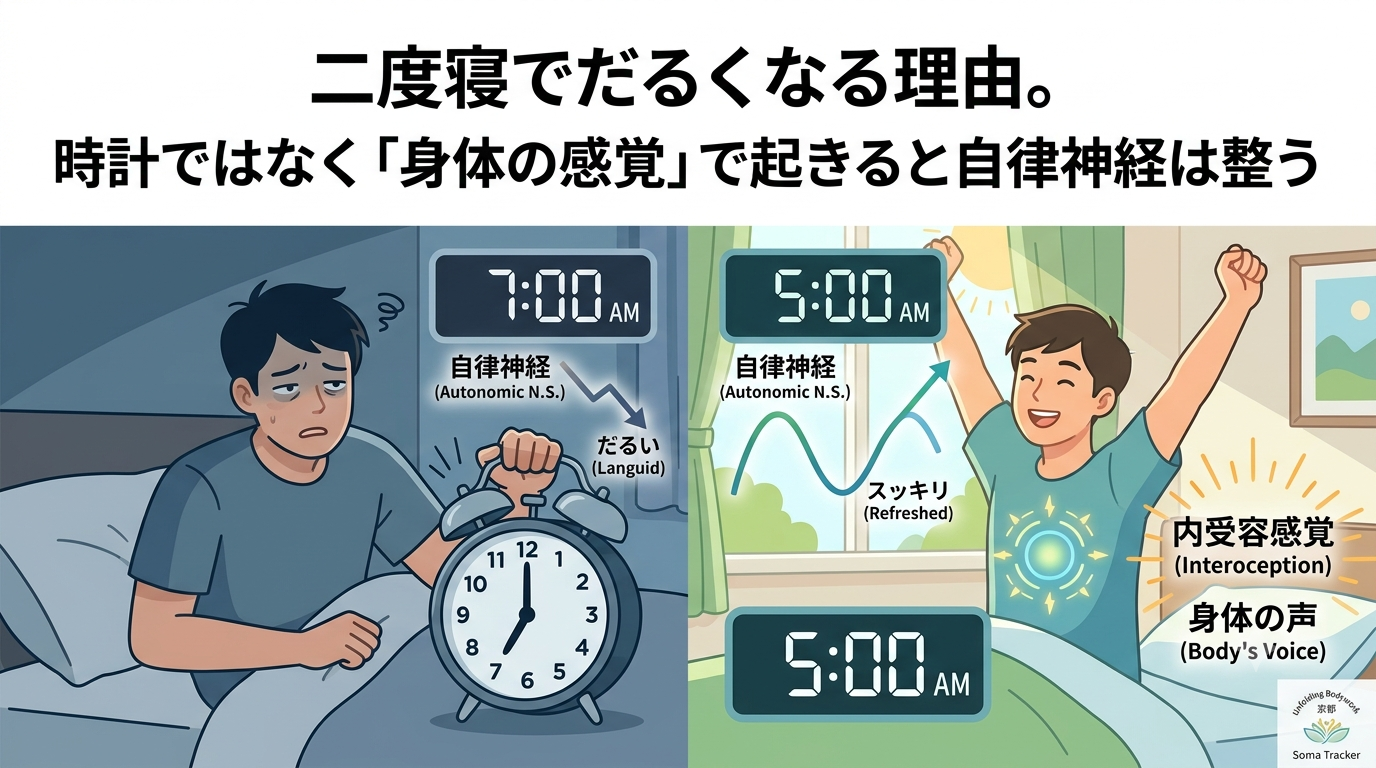
A morning when you awaken effortlessly. Your mind is clear, pristine, and entirely free of lingering slumber.
Yet, upon glancing at the smartphone by your pillow, have you ever found yourself thinking:
"They say 'the ideal sleep is seven to eight hours,' and it's still too early—I should drift back to sleep."
And then, forcing yourself into a secondary sleep, only to be pulled awake by your alarm at 7:00 AM—
"Wait...? Why does my head feel so heavy, and my body so sluggish, far more than when I first opened my eyes?"
Surely, everyone has experienced this sensation at least once.
Without realizing it, we attempt to forcibly govern our bodies through "the digits on the clock" and "societal health rules (the mind's constructs)."
📌 Key Takeaways: The Autonomic Nervous System & Sleep
- The restorative quality of sleep is deeply tied not merely to "duration," but to "sleep density"—characterized by continuity and depth.
- Forcing yourself back to sleep after your energetic battery is fully recharged interrupts your sleep cycle, easily giving rise to "sleep inertia (sluggishness and heaviness)."
- Waking in trust of your internal clarity—rather than the clock's numerals—cultivates the harmony of your autonomic nervous system (Interoception).
- Autonomic measurement data (Soma Tracker) serves as a steadfast companion to help you reclaim conviction in your own bodily sensations.
1. The Secret to Sleep Quality Lies in "Density," Not Just "Duration"
We are often inclined to believe that "the longer one sleeps, the greater the restoration," but observing autonomic nervous system data reveals a slightly different reality.
No matter how many hours you spend in bed—if you wake repeatedly through the night, or if mental tension prevents your sleep from deepening—your body will not find true repose.
Conversely, even with six to six-and-a-half hours of rest, if you achieve "high-density sleep" as outlined below, your body's battery is beautifully charged.
- Unbroken, deep sleep with minimal nocturnal awakenings immediately following sleep onset
- Heart rate settles smoothly in the dead of night, with natural detensifying of muscles and visceral organs
- Passing through "Peak Self-Repair" where autonomic activation (RMSSD) rises robustly
When this restorative process completes between 4:00 and 5:00 AM, the body naturally initiates a gentle wakeful switch, whispering, "I am already fully charged."
2. Why "Forced Snoozing" Heavying the Body
Even when the body has gracefully prepared itself for clarity, forcing yourself back to sleep simply because "the clock is still early" creates a physiological dissonance.
⚠️ The Process by Which Forced Snoozing Generates "Sluggishness"
- The body has already completed a smooth descent into morning active mode.
- Forcing a return to sleep half-heartedly plunges you back into the deep slumber of a fresh sleep cycle.
- Being jerked awake by an alarm mid-deep sleep produces profound grogginess and mental heaviness (sleep inertia).
The true identity of that regretful sluggishness—"I should have just gotten up earlier..."—is simply the consequence of suppressing the body's natural awakening signal through the intellect (the rules of the clock).
3. Entrusting Ourselves to "Interoception" (The Voice of the Body)
In neuroscience, the innate capacity to perceive internal bodily sensations—such as heart rate settling, breath deepening, core warmth, and clear-headedness—is termed "Interoception."
- The Mind's Rules (The Intellect): "I must sleep for seven hours," "It's only 5 AM, so I must stay in bed."
- The Body's Voice (Interoception): "My mind is clear," "My core feels light," "I am ready to move."
True wellness does not mean forcibly fitting the body into external rules or numerical targets; rather, it is making "How does my body feel right now?" your cherished compass.
If your body feels "crisp and newly awakened," step out of bed even at five in the morning and welcome the gentle dawn. That remains the most harmonious choice for your autonomic nervous system.
4. Autonomic Data Acts as a "Walking Stick" to Trust Your Sensations
And yet, for modern individuals who have spent years prioritizing the "intellect," immediately trusting one's own bodily sensations alone may feel slightly unnerving.
In such moments, "objective autonomic data" offers a quiet, reassuring pillar of support.
When sleep data is analyzed using "Soma Tracker," the autonomic measurement system developed at Unfolding Bodywork, undeniable facts manifest as numeric values before your eyes the moment you wake.
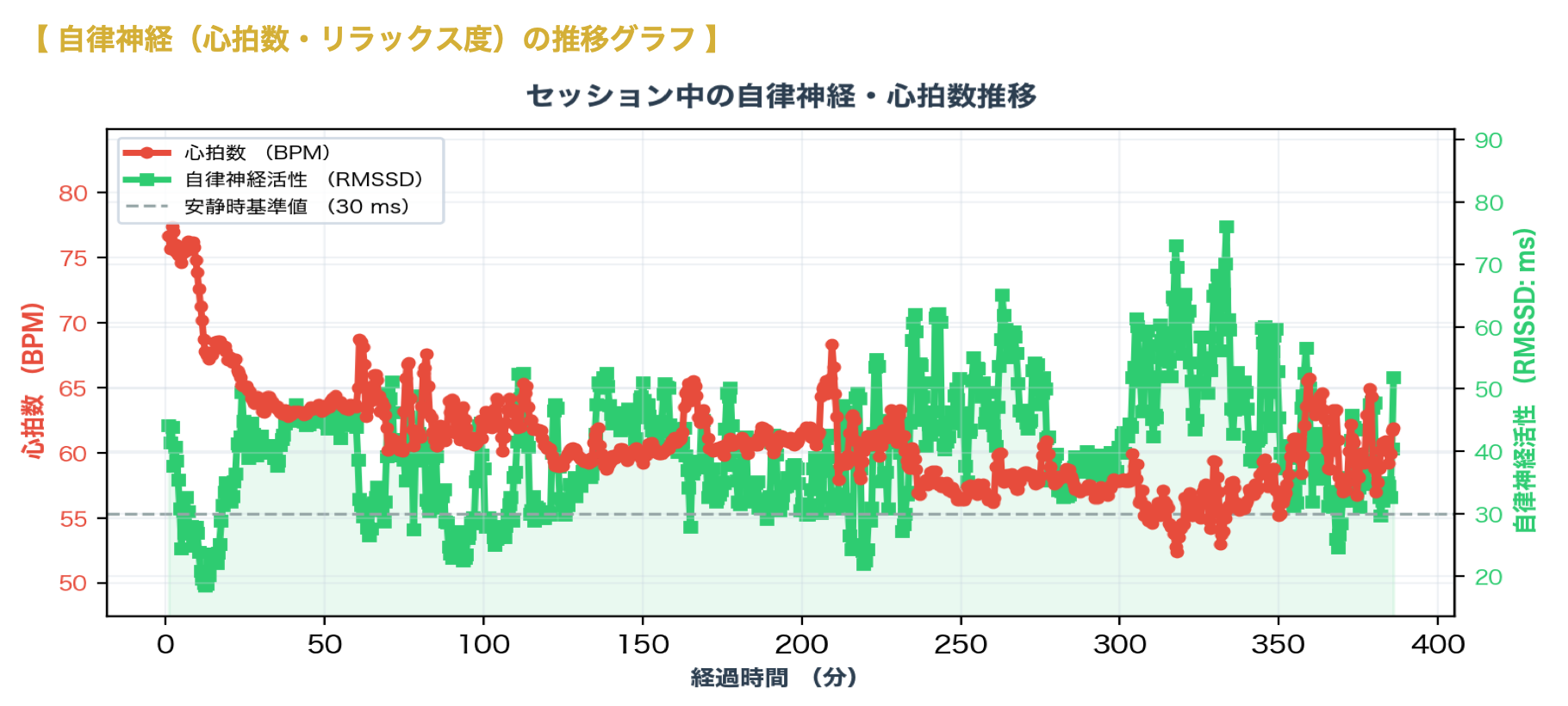
Progression of heart rate and autonomic recovery during a night of sleep
● Average Heart Rate: 61.2 bpm (Deeply quieted to 56 bpm at night)
● Autonomic Activation (RMSSD): 41.7 ms (Maintaining an optimal recovery threshold)
● Overall Autonomic Capacity (SDNN): 86.1 ms (Supplying resilient psycho-physical spaciousness)
● Peak Self-Repair: Reached at 04:04 AM (Respiratory coherence: 91.2%)
A single glance at these measurements reveals:
"Ah, my physical sense of 'crisp clarity' was entirely accurate."
"My overnight restoration was properly completed by 4:00 AM."
Thus, you develop a deep conviction and peace of mind in your own interoceptive awareness.
Data is not meant to manage or constrain the body, but rather to serve as "a supportive ally in trusting the voice of your own form."
5. Awakening to the Body's Voice Harmonizes Even Tonight's Sleep
When you awaken at the optimal moment guided by physical sensation, a virtuous cycle unfolds, circulating harmoniously not only through your day, but extending gracefully into your sleep tonight.
-
Your internal clock resets naturally
Bathing in morning light at an early hour encourages pleasant serotonin secretion, naturally synchronizing your circadian rhythm. -
A lucid, enduring focus persists from the morning onward
Unencumbered by sleep inertia (sluggishness), you engage the day with pristine consciousness from the very first hour. -
Natural, profound drowsiness arrives by night
Serotonin reset in the morning shifts smoothly toward melatonin as evening falls, gently lulling you into deep nighttime repose.
We so easily find ourselves trying to control everything with our minds: "How many hours did I sleep?" "What must I accomplish?"
Yet the body possesses a flawless self-regulatory system (the autonomic nervous system) cultivated through millions of years of adaptation. It quietly knows precisely what is needed, at every moment.
Letting go of the clock for a moment, let us listen closely to the sensations of the form.
That small accumulation of trust gently harmonizes your autonomic nervous system, unbinding your mind and body into their inherently free state (Unfolding).
If you wake early this morning and feel wonderfully clear—please, take it with complete confidence and step into a radiant morning anew.
❓ Frequently Asked Questions (FAQ) on Sleep & Interoception
Q. Is it truly acceptable to sleep for less than seven hours?
A. Yes. When nocturnal awakenings are minimal and deep rest is condensed, there are days when six hours is entirely sufficient to harmonize your internal flow. Rather than numerical duration, let "the clear-headedness and absence of drowsiness the moment you wake (interoception)" be your guiding metric.
Q. How should I care for myself on days when I accidentally fall back asleep?
A. When experiencing sluggishness from secondary sleep (sleep inertia), refreshing your hands and feet with lukewarm water, drinking a glass of water, and basking in morning sunlight will help smoothly switch your system back into sympathetic activation.